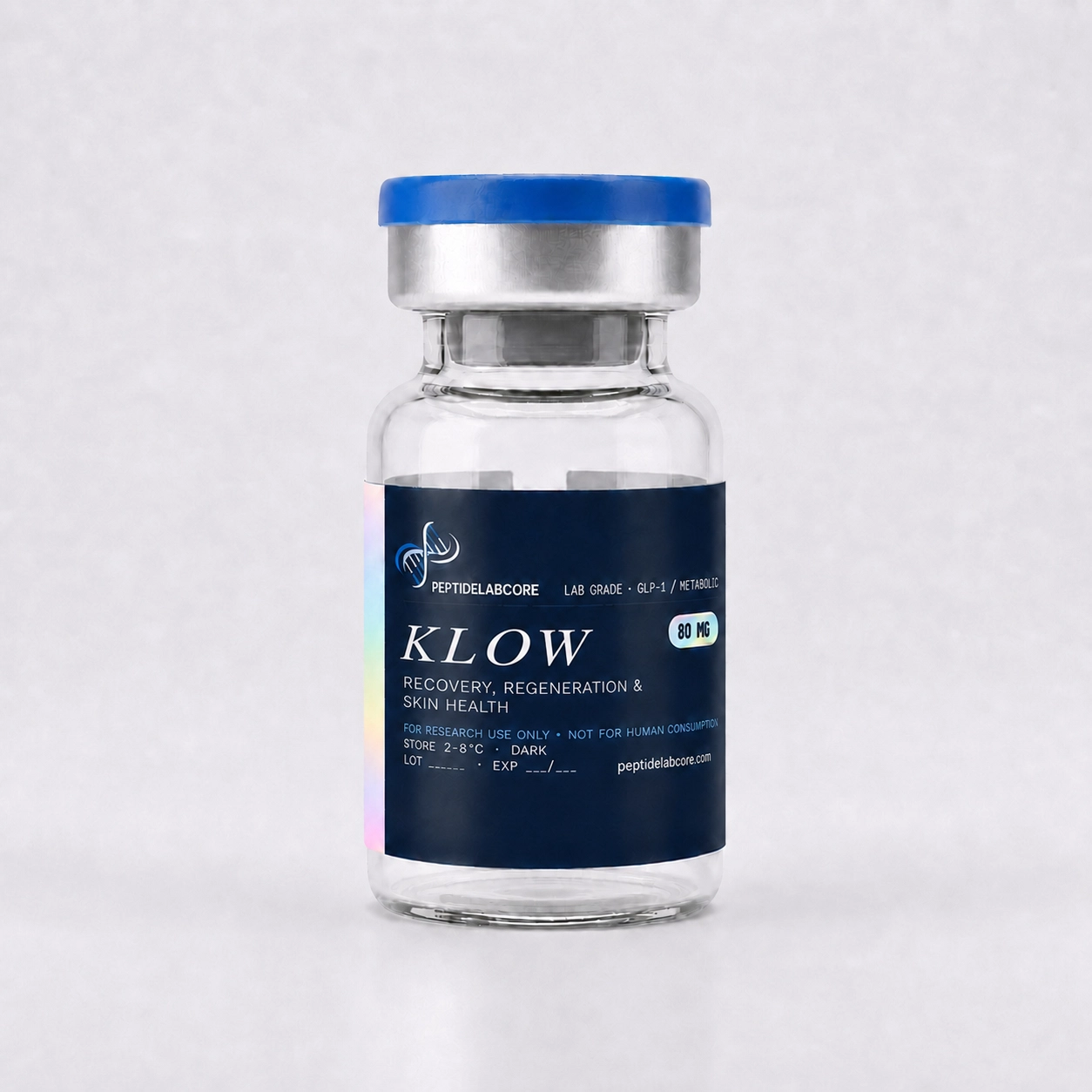
KLOW 80MG
$69.99
KLOW 80MG (80mg x 10) is a high-purity research peptide blend combining GHK-Cu, BPC-157, TB-500, and KPV in a single lyophilized vial. Each batch undergoes independent third-party testing to verify identity and purity (>99%). With a total blend mass of 80mg per vial, this research chemical is intended exclusively for laboratory and in vitro experimentation. For research use only — not for human consumption.
KLOW 80MG Research Peptide Blend — Quad-Compound Formulation for Laboratory Use
Product Overview
KLOW 80MG is a research-grade multi-peptide blend supplied as a sterile lyophilized powder in sealed vials. Each package contains ten vials, with each vial holding a total of 80mg of combined research compounds. This product is manufactured exclusively for scientific investigation and in vitro laboratory experimentation .
Key Specifications at a Glance:
Quantity: 80mg total per vial, 10 vials per pack
Form: Lyophilized (freeze-dried) powder
Purity: >99% verified by third-party testing
Composition: GHK-Cu (50mg), BPC-157 (10mg), TB-500 (10mg), KPV (10mg)
CAS Numbers: 946870-92-4, 77591-33-4, 67727-97-3, 49557-75-7
PubChem CIDs: 125672, 16132341, 13294447, 73587
Research Use Only: Not for human or animal consumption
Understanding KLOW: The Research Context
KLOW is a research-grade peptide stack formulated as a predefined combination of multiple peptides within a single 80mg vial. It is designed for analytical and experimental use, allowing researchers to work with a standardized formulation rather than managing individual peptides separately .
The Four Components of KLOW:
| Component | Quantity per Vial | Primary Research Interest |
|---|---|---|
| GHK-Cu | 50mg | Copper-mediated gene regulation, collagen synthesis, extracellular matrix remodeling |
| BPC-157 | 10mg | Growth factor modulation, cytoprotective signaling, soft-tissue repair |
| TB-500 | 10mg | Actin sequestration, cell migration, angiogenesis |
| KPV | 10mg | NF-κB inhibition, inflammatory cytokine modulation |
This structured formulation supports research into peptide synergy, where multiple peptides are combined to be studied together rather than in isolation .
The Significance of Peptide Stacks in Research:
In research settings, stacked formulations allow investigators to observe how peptides may interact, complement one another, or influence overall stability and performance when used as a group. Instead of focusing on one signaling pathway or molecular interaction, a peptide stack enables a broader, more integrated area of study .
Third-Party Testing and Quality Assurance
Every batch of KLOW 80MG undergoes rigorous independent analytical testing to verify identity, purity, and consistency. This third-party testing ensures that researchers receive a product that meets strict quality specifications before it is approved for release .
The testing process includes:
Identity verification through mass spectrometry
Purity analysis using high-performance liquid chromatography (HPLC)
Batch-to-batch consistency checks
Endotoxin testing to confirm sterility
Residual solvent analysis to confirm complete lyophilization
Sample Test Results (Batch KL800226j):
GHK-Cu: 58.15 mg
KPV: 15.92 mg
BPC-157: 15.99 mg
TB-500 (TB4): 15.96 mg
Purity: 99.8%
Endotoxins: None Detected
With verified purity exceeding 99% and independent laboratory confirmation of component masses, KLOW 80MG meets the high standards required for serious laboratory research applications .
Component Profiles: The Four Peptides
GHK-Cu (50mg) — The Copper Peptide
GHK-Cu is a naturally occurring copper-binding tripeptide with the sequence Glycine-Histidine-Lysine. It has been extensively studied for its role in gene expression modulation and tissue remodeling.
Key Research Interests:
Collagen and elastin synthesis stimulation
Extracellular matrix (ECM) remodeling
Wound healing pathway activation
Antioxidant defense gene regulation
GHK-Cu acts as a potent chemoattractant for macrophages, mast cells, and capillary endothelial cells in laboratory models. The peptide modulates approximately 31% of human genes with ≥50% expression changes, making it a significant regulator of cellular function .
BPC-157 (10mg) — The Body Protection Compound
BPC-157 is a synthetic pentadecapeptide derived from a gastric protein. It has been studied for its cytoprotective and tissue-repair properties.
Key Research Interests:
Growth factor receptor modulation
Nitric oxide signaling pathways
Tendon, ligament, and muscle healing models
Gastrointestinal barrier integrity
BPC-157 promotes tissue regeneration through FAK-paxillin pathway activation, dramatically increasing phosphorylation of focal adhesion kinase and paxillin proteins without changing total protein amounts .
TB-500 (10mg) — The Thymosin Beta-4 Fragment
TB-500 is a synthetic fragment of thymosin beta-4, corresponding to amino acids 17-23 (Ac-LKKTETQ). It has been studied for its role in actin binding and cell migration.
Key Research Interests:
Actin sequestration and cytoskeletal dynamics
Endothelial cell migration and angiogenesis
Wound healing and reepithelialization
Anti-inflammatory pathway modulation
TB-500 acts as a potent endothelial cell chemoattractant, stimulating 4-6-fold increases in HUVEC migration in laboratory studies. The peptide’s activity is observed at approximately 50 nanomolar concentration .
KPV (10mg) — The Anti-Inflammatory Tripeptide
KPV is a synthetic tripeptide (Lysine-Proline-Valine) corresponding to the C-terminal fragment of alpha-melanocyte stimulating hormone (α-MSH). It has been studied for its anti-inflammatory properties independent of melanocortin receptor binding.
Key Research Interests:
NF-κB pathway inhibition
Pro-inflammatory cytokine (TNF-α, IL-6) reduction
Mast cell activation regulation
Intestinal epithelial cell signaling
KPV inhibits NF-κB activation at nanomolar concentrations through stabilization of IκB-α and prevention of p65/RelA nuclear translocation. The tripeptide enters cells via the PepT1 transporter and reduces pro-inflammatory cytokine secretion in intestinal epithelial cells and macrophages .
Research Applications
KLOW 80MG is used in various laboratory research contexts, allowing investigators to study multiple pathways simultaneously. Typical applications include :
Tissue Repair and Regeneration Studies:
Collagen deposition and extracellular matrix remodeling
Fibroblast migration and activation
Wound healing kinetics in controlled models
Angiogenesis and Vascular Research:
Endothelial cell migration and proliferation
Growth factor expression (VEGF, bFGF)
Capillary formation and vascular density
Inflammatory Pathway Investigations:
Cytokine and chemokine expression profiles
NF-κB signaling modulation
Macrophage and mast cell activation
Multi-Pathway Cell Studies:
Parallel signaling pathway analysis
Comparative mechanism research
Synergistic effect analysis
Cell Culture Investigations:
Cellular responses to peptide combinations
Gene expression changes following treatment
Cell viability and proliferation under various conditions
Researchers should design their experimental protocols based on peer-reviewed literature and established laboratory practices specific to multi-peptide formulations.
Chemical and Physical Properties
Molecular Characteristics of Each Component
| Component | Molecular Formula | Molecular Mass | CAS Number | PubChem CID |
|---|---|---|---|---|
| GHK-Cu | C₁₄H₂₃CuN₆O₄ | 401.91 g/mol | 49557-75-7 | 73587 |
| BPC-157 | C₆₂H₉₈N₁₆O₂₂ | 1419.5 g/mol | 137525-51-0 | 9941957 |
| TB-500 | C₂₁₂H₃₅₀N₅₆O₇₈S | 4963.55 g/mol | 77591-33-4 | 16132341 |
| KPV | C₁₇H₃₂N₆O₄ | 384.48 g/mol | 67727-97-3 | 125672 |
Physical Form and Storage
The product is supplied as a lyophilized (freeze-dried) powder within a sterile, sealed vial. The blend appears as a homogeneous, off-white to pale blue substance due to the copper content of GHK-Cu .
Recommended Storage Conditions:
Store lyophilized powder at -20°C (-4°F) or below for long-term preservation
Protect from light exposure
Keep desiccated to prevent moisture absorption
Allow vial to reach room temperature before opening to avoid condensation
Avoid repeated freeze-thaw cycles once reconstituted
Stability Considerations:
Lyophilized KLOW has a shelf life of approximately 24 months when stored properly. Once reconstituted, the solution should be refrigerated at 2-8°C (35.6-46.4°F) and used within the timeframe specified by laboratory protocols. Freezing after reconstitution is not recommended as it may affect peptide integrity .
Intended Use and Regulatory Status
Research Use Only
KLOW 80MG is classified as a research chemical and is intended exclusively for laboratory and in vitro experimentation. This designation means the product is sold strictly for:
In vitro testing — experiments conducted in controlled laboratory environments
Cell culture studies — investigating multi-peptide interactions with cellular systems
Multi-pathway research — studying concurrent receptor and signaling pathway interactions
Analytical research — chemical analysis and characterization studies
Scientific investigation — basic research into peptide structure and function
Important Regulatory Notice
This product is not a drug, food, cosmetic, or medical device. Bodily introduction of any kind into humans or animals is strictly forbidden by law. The product should only be handled by licensed, qualified professionals working in appropriate laboratory facilities .
The supplier is a chemical supplier, not a compounding pharmacy or outsourcing facility under Sections 503A or 503B of the Federal Food, Drug, and Cosmetic Act. All product information provided is for educational purposes only and does not constitute medical advice or clinical recommendations.
Handling and Safety Guidelines
Professional Handling Required
KLOW 80MG should only be handled by trained laboratory personnel wearing appropriate personal protective equipment (PPE), including:
Laboratory coat
Nitrile gloves
Safety goggles or face shield
Appropriate respiratory protection if aerosolization is possible
Reconstitution Protocol
For laboratory use, the lyophilized powder should be reconstituted with a sterile, compatible solvent. Standard practice includes :
Allow the sealed vial to reach room temperature — approximately 15-30 minutes
Clean the rubber stopper with an alcohol swab
Add 3.0 mL of bacteriostatic water (or appropriate sterile solvent) slowly down the vial wall
Gently swirl or roll the vial between palms — do not shake vigorously to avoid foaming
Allow complete dissolution before use — this typically takes 5-10 minutes
Reconstitution Results with 3.0 mL solvent:
Total concentration: ~26.7 mg/mL
TB-500 concentration: ~3.33 mg/mL (33.3 mcg per unit)
BPC-157 concentration: ~3.33 mg/mL (33.3 mcg per unit)
KPV concentration: ~3.33 mg/mL (33.3 mcg per unit)
GHK-Cu concentration: ~16.7 mg/mL (166.7 mcg per unit)
For alternative reconstitution volumes, researchers should calculate concentrations based on their specific experimental requirements .
Disposal Considerations
Dispose of KLOW 80MG and any contaminated materials in accordance with federal, state, and local regulations for chemical waste disposal. Do not dispose of in regular trash or down drains unless permitted by local guidelines.
What Makes This Product Different
Pre-Formulated Multi-Peptide Stack
Unlike individual research peptides that require separate handling, reconstitution, and storage, KLOW combines four complementary peptides into a single vial. This structured approach supports consistency, efficiency, and reproducibility in peptide-focused research settings .
Cost-Effective Research Tool
KLOW typically costs 15-20% less than purchasing all four peptides individually, plus it simplifies storage, reconstitution, and administration in research protocols requiring all four compounds .
Synergistic Research Potential
The combination of GHK-Cu, BPC-157, TB-500, and KPV allows researchers to study multiple complementary pathways simultaneously. This includes copper-mediated ECM activation, cytoprotective signaling, actin-dependent cell motility, and immune-modulatory pathways .
Rigorous Quality Control
Unlike research chemicals sold without verification, KLOW 80MG comes with documented third-party testing for every batch. Independent laboratory verification includes:
Mass spectrometry for identity confirmation
HPLC for purity analysis (>99%)
Endotoxin testing (none detected)
Batch-specific certificates of analysis
Complete Documentation
Each product listing includes full chemical specifications, including molecular formulas, molecular masses, CAS numbers, and PubChem CIDs for each component. This transparency allows researchers to verify the exact compounds they are working with.
Appropriate Packaging for Research Use
The sterile, sealed vial packaging protects the lyophilized powder from environmental contaminants. The 80mg concentration is specifically designed for researchers who require a standardized multi-peptide formulation.
Batch Traceability
Each package of KLOW 80MG includes batch identification numbers that allow researchers to trace their material back to original manufacturing and testing records. This traceability is essential for reproducible research and quality documentation .
Frequently Asked Questions for Researchers
What is the purity level of KLOW 80MG?
Each batch is tested to verify purity exceeding 99%. Individual certificates of analysis are available upon request, with recent batches showing 99.8% purity .
What is the exact composition of KLOW 80MG?
KLOW contains four research peptides: GHK-Cu (50mg), BPC-157 (10mg), TB-500 (10mg), and KPV (10mg) for a total of 80mg per vial .
How should the lyophilized powder be stored?
Store at -20°C or below, protected from light and moisture. The lyophilized powder has a shelf life of approximately 24 months .
What solvent should be used for reconstitution?
The standard protocol recommends 3.0 mL of bacteriostatic water. Researchers should determine the appropriate solvent based on their specific experimental protocol. Common options include sterile water for injection or buffered solutions such as phosphate-buffered saline (PBS) .
Is this product sterile?
The lyophilized powder is manufactured under aseptic conditions, and endotoxin testing confirms no detectable endotoxins. However, researchers should follow standard laboratory practices for handling research chemicals. For cell culture applications, additional filtration using a 0.22-micron filter may be appropriate .
What is the significance of the blue color?
The pale blue tint of the lyophilized powder is characteristic of GHK-Cu, which contains copper and naturally appears blue to blue-green in color .
Is KLOW more cost-effective than buying peptides separately?
Yes, KLOW typically costs 15-20% less than purchasing all four peptides individually, plus it simplifies storage, reconstitution, and administration in research protocols requiring all four compounds .
Can KLOW be used in combination with other research reagents?
Researchers should determine compatibility based on their specific experimental design. Standard laboratory practice includes testing interactions in control experiments before full-scale implementation.
What research applications is KLOW used for?
KLOW is studied in tissue regeneration research, wound healing models, inflammatory response investigations, angiogenesis studies, and cell migration assays in laboratory cell cultures .
Final Notes for Laboratory Researchers
KLOW 80MG represents a high-purity research tool for qualified professionals conducting legitimate scientific investigations into multi-pathway peptide interactions, tissue regeneration, inflammation modulation, and related fields. With documented third-party testing, complete chemical specifications, and appropriate packaging for laboratory use, this product meets the standards expected by serious researchers .
The pre-formulated quad-compound blend offers researchers the ability to study complementary mechanisms simultaneously, including copper-mediated extracellular matrix activation (GHK-Cu), cytoprotective signaling (BPC-157), actin-dependent cell motility (TB-500), and immune-modulatory pathways (KPV) .
For research use only. Not for human or animal consumption. Handle only in appropriate laboratory facilities with proper safety equipment and training.