MT-2
$34.99
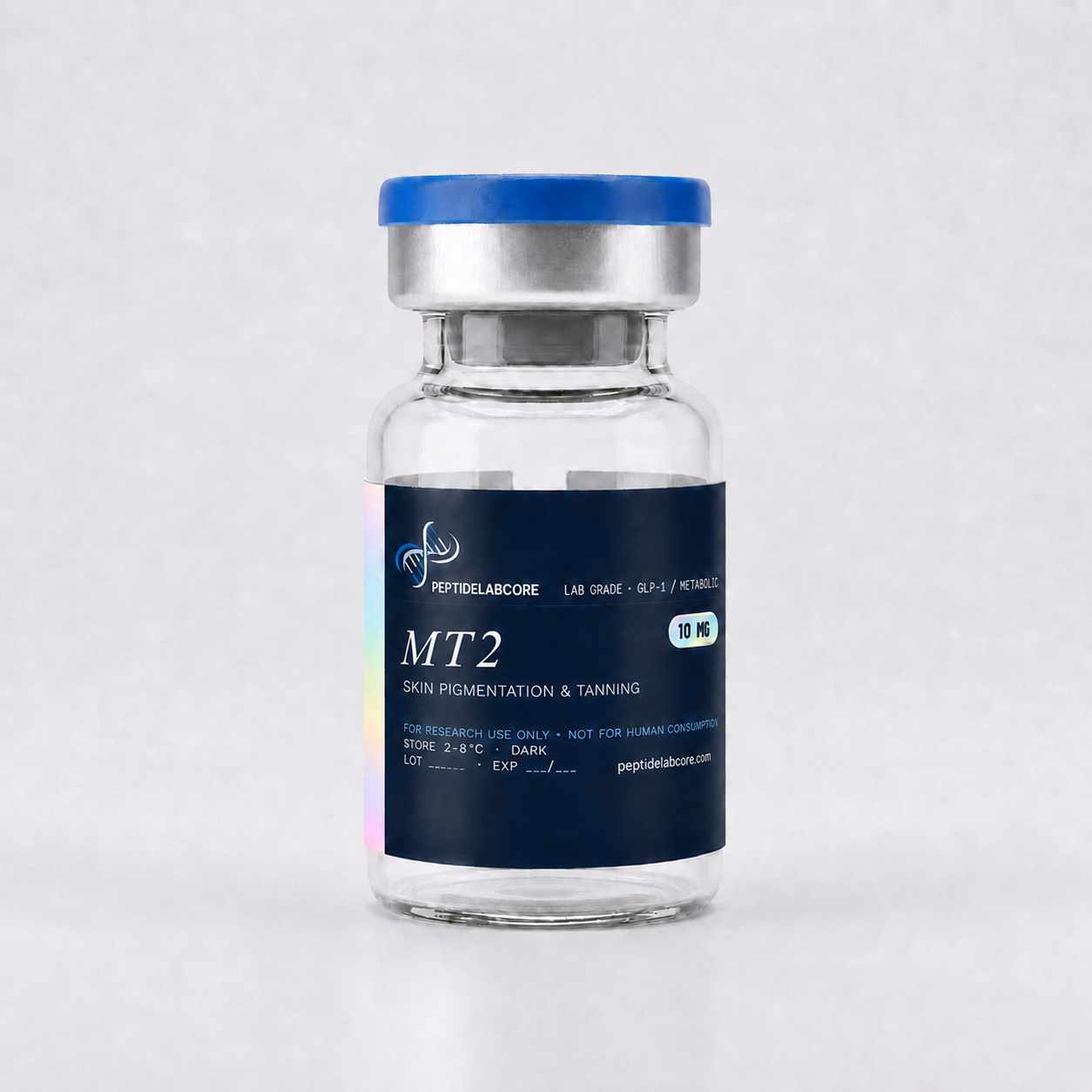
MT-2 (10mg x 10) is a high-purity synthetic cyclic research peptide analog of alpha-melanocyte stimulating hormone (α-MSH). Supplied as a lyophilized powder in sterile vials, each batch undergoes independent third-party testing to verify identity and purity (>98%). With a molecular mass of 1024.2 and CAS number 121062-08-6, this research chemical is intended exclusively for laboratory and in vitro experimentation. For research use only — not for human consumption.
MT-2 Research Peptide — High-Purity Synthetic Melanocortin Analog for Laboratory Use
Product Overview
MT-2 (Melanotan-II) is a research-grade synthetic cyclic peptide analog of alpha-melanocyte stimulating hormone (α-MSH). It is supplied as a sterile lyophilized powder in sealed vials. Each package contains ten vials, with each vial holding 10mg of the research compound. This product is manufactured exclusively for scientific investigation and in vitro laboratory experimentation.
Key Specifications at a Glance:
Quantity: 10mg per vial, 10 vials per pack
Form: Lyophilized (freeze-dried) powder
Purity: >98% verified by third-party testing
Molecular Formula: C₅₀H₆₉N₁₅O₉
Molecular Mass: 1024.2
CAS Number: 121062-08-6
Sequence: Ac-Nle-cyclo[Asp-His-D-Phe-Arg-Trp-Lys]-NH₂
Synonyms: Melanotan-II, MT-II, MTII
Research Use Only: Not for human or animal consumption
Understanding MT-2: The Research Context
MT-2 (Melanotan-II) is a synthetic cyclic heptapeptide developed as an analog of alpha-melanocyte stimulating hormone (α-MSH). Unlike its linear counterpart Melanotan-I (MT-1), MT-2 features a cyclic structure created by a lactam bridge between aspartic acid and lysine residues at positions 5 and 10 of the peptide chain.
Key Research Interests:
Melanocortin receptor binding and selectivity studies
Melanogenesis (pigmentation) pathway research
Appetite regulation and metabolic studies
Central nervous system receptor interactions
In vitro cell culture investigations
Researchers utilize MT-2 in controlled laboratory settings to study melanocortin receptor biology. The peptide is of particular interest to investigators focused on MC1R (melanocortin 1 receptor) signaling, pigmentation mechanisms, and the broader melanocortin receptor family which includes MC1R through MC5R.
The Significance of the Cyclic Structure:
MT-2 was designed with a lactam bridge between positions 5 and 10 of the peptide sequence, creating a cyclic conformation. This structural feature was developed based on NMR and computer modeling that suggested a salt bridge exists between Glu5 and Lys11 in natural α-MSH. The cyclic structure provides greater metabolic stability compared to linear peptides and restricts conformational flexibility, making MT-2 a valuable research tool for studying constrained peptide-receptor interactions.
MT-2 and the Melanocortin Receptor Family
The melanocortin system consists of five known G-protein coupled receptors (GPCRs): MC1R through MC5R. These receptors are activated by melanocortin peptides derived from proopiomelanocortin (POMC) and are distributed throughout the body with diverse physiological functions.
Receptor Targets of MT-2:
| Receptor | Primary Distribution | Research Interest |
|---|---|---|
| MC1R | Melanocytes, skin | Pigmentation, melanogenesis |
| MC3R | Brain, placenta | Energy homeostasis, feeding behavior |
| MC4R | Hypothalamus, brain | Appetite regulation, energy balance |
| MC5R | Widespread (exocrine glands) | Exocrine gland function |
MT-2 acts as an agonist at multiple melanocortin receptor subtypes, making it a non-selective melanocortin receptor agonist. This receptor profile distinguishes MT-2 from more selective analogs like MT-1, which primarily targets MC1R.
MT-2 vs. MT-1 (Melanotan-I): A Research Comparison
Researchers often compare MT-2 with MT-1, as both are α-MSH analogs with distinct properties.
| Feature | MT-2 (Melanotan-II) | MT-1 (Melanotan-I) |
|---|---|---|
| Structure | Cyclic heptapeptide (lactam bridge) | Linear 13-amino acid peptide |
| Sequence | Ac-Nle-cyclo[Asp-His-D-Phe-Arg-Trp-Lys]-NH₂ | [Nle⁴-D-Phe⁷]-α-MSH |
| Molecular Mass | 1024.2 | ~1646 |
| Receptor Selectivity | Non-selective (MC1R, MC3R, MC4R, MC5R) | MC1R-selective |
| Primary Research Focus | Multiple melanocortin pathways | Pigmentation/MC1R-specific studies |
| Structural Stability | High (cyclic) | Moderate (linear) |
Choosing Between MT-2 and MT-1:
Researchers focused specifically on MC1R-mediated pigmentation pathways may prefer MT-1 due to its greater receptor selectivity. Investigators studying broader melanocortin system effects, including potential interactions with MC3R, MC4R, or MC5R, may find MT-2 more appropriate for their experimental designs.
Third-Party Testing and Quality Assurance
Every batch of MT-2 undergoes rigorous independent analytical testing to verify identity, purity, and consistency. This third-party testing ensures that researchers receive a product that meets strict quality specifications before it is approved for release.
The testing process includes:
Identity verification through mass spectrometry
Purity analysis using high-performance liquid chromatography (HPLC)
Purity confirmation via SDS-PAGE analysis
Batch-to-batch consistency checks
Residual solvent analysis to confirm complete lyophilization
With a verified purity exceeding 98%, MT-2 meets the high standards required for serious laboratory research applications. Each vial contains only the lyophilized research compound with no unnecessary additives, fillers, or excipients.
Chemical and Physical Properties
Molecular Characteristics
MT-2 is a synthetic cyclic heptapeptide with a unique structure that includes a lactam bridge cyclizing the molecule between the aspartic acid (Asp) and lysine (Lys) residues.
Detailed Molecular Information:
Molecular Formula: C₅₀H₆₉N₁₅O₉
Molecular Mass: 1024.2 daltons
CAS Number: 121062-08-6
Sequence: Ac-Nle-cyclo[Asp-His-D-Phe-Arg-Trp-Lys]-NH₂
IUPAC Name: (3S,6S,9R,12S,15S,23S)-15-[[(2S)-2-acetamidohexanoyl]amino]-9-benzyl-6-[3-(diaminomethylideneamino)propyl]-12-(1H-imidazol-5-ylmethyl)-3-(1H-indol-3-ylmethyl)-2,5,8,11,14,17-hexaoxo-1,4,7,10,13,18-hexazacyclotricosane-23-carboxamide
Structural Features:
Cyclic heptapeptide with lactam bridge
Contains D-Phe (D-phenylalanine) at position 7
Acetylated N-terminus
Amidated C-terminus
Nle (norleucine) substitution for methionine
Water-soluble compound
The presence of D-Phe (the D-isomer of phenylalanine) is a notable structural feature. Most naturally occurring peptides contain only L-amino acids, so the inclusion of a D-amino acid makes MT-2 a non-natural synthetic peptide with enhanced stability against enzymatic degradation.
Physical Form and Storage
The product is supplied as a lyophilized (freeze-dried) powder within a sterile, sealed vial. Lyophilization preserves the chemical integrity of the peptide by removing water content while maintaining the compound’s structure.
Recommended Storage Conditions:
Store lyophilized powder at -20°C (-4°F) or below for long-term preservation
Protect from light exposure
Keep desiccated to prevent moisture absorption
Allow vial to reach room temperature before opening to avoid condensation
Avoid repeated freeze-thaw cycles once reconstituted
Stability Considerations:
Lyophilized MT-2 is stable at room temperature for up to 3 weeks but should be stored desiccated below -18°C for long-term preservation. Upon reconstitution, MT-2 solutions should be stored at 4°C for 2-7 days. For extended storage after reconstitution, freezing below -18°C is recommended, preferably with the addition of a carrier protein such as 0.1% HSA or BSA to enhance stability.
Once reconstituted with an appropriate sterile solvent, the solution should be used according to laboratory protocols.
Intended Use and Regulatory Status
Research Use Only
MT-2 is classified as a research chemical and is intended exclusively for laboratory and in vitro experimentation. This designation means the product is sold strictly for:
In vitro testing — experiments conducted in controlled laboratory environments
Cell culture studies — investigating peptide interactions with cellular systems
Receptor binding assays — studying melanocortin receptor interactions
Melanogenesis research — pigmentation pathway investigations
Analytical research — chemical analysis and characterization studies
Scientific investigation — basic research into peptide structure and function
Important Regulatory Notice
This product is not a drug, food, cosmetic, or medical device. Bodily introduction of any kind into humans or animals is strictly forbidden by law. The product should only be handled by licensed, qualified professionals working in appropriate laboratory facilities.
The supplier is a chemical supplier, not a compounding pharmacy or outsourcing facility under Sections 503A or 503B of the Federal Food, Drug, and Cosmetic Act. All product information provided is for educational purposes only and does not constitute medical advice or clinical recommendations.
Handling and Safety Guidelines
Professional Handling Required
MT-2 should only be handled by trained laboratory personnel wearing appropriate personal protective equipment (PPE), including:
Laboratory coat
Nitrile gloves
Safety goggles or face shield
Appropriate respiratory protection if aerosolization is possible
Reconstitution Protocol
For laboratory use, the lyophilized powder should be reconstituted with a sterile, compatible solvent. Standard practice includes:
Allow the sealed vial to reach room temperature — approximately 15-30 minutes
Clean the rubber stopper with an alcohol swab
Add the calculated volume of solvent to achieve desired concentration
Gently swirl or roll the vial between palms — do not shake vigorously to avoid foaming
Allow complete dissolution before use — this typically takes 2-5 minutes
Reconstitution Example for MT-2:
For researchers needing a 5mg/mL working solution, add 2mL of sterile solvent to the 10mg vial. For a 10mg/mL solution, add 1mL of solvent. For a 2mg/mL solution, add 5mL of solvent. For a 1mg/mL solution, add 10mL of solvent. Always verify calculations before proceeding with experiments.
Solvent Considerations:
It is recommended to reconstitute lyophilized MT-2 in sterile 18MΩ-cm water at a concentration not less than 100 µg/mL, which can then be further diluted with other aqueous solutions. Researchers should determine the appropriate solvent based on their specific experimental protocol. Common options include sterile water for injection, bacteriostatic water, or buffered solutions such as phosphate-buffered saline (PBS).
Disposal Considerations
Dispose of MT-2 and any contaminated materials in accordance with federal, state, and local regulations for chemical waste disposal. Do not dispose of in regular trash or down drains unless permitted by local guidelines.
Research Applications
MT-2 is used in various laboratory research contexts, primarily focused on melanocortin receptor pharmacology. Typical applications include:
Melanocortin Receptor Binding Studies:
The primary research interest in MT-2 revolves around its interaction with multiple melanocortin receptor subtypes. Researchers use MT-2 to study:
Receptor binding affinity and kinetics at MC1R, MC3R, MC4R, and MC5R
Selectivity profiles among melanocortin receptor subtypes
Competitive binding assays with endogenous melanocortin ligands
Structure-activity relationships (SAR) of cyclic melanocortin agonists
G-Protein Coupled Receptor (GPCR) Research:
Melanocortin receptors are members of the GPCR superfamily. MT-2 serves as a research tool for:
GPCR activation mechanisms and conformational changes
Second messenger signaling pathways (cAMP, IP3, calcium)
Receptor internalization and desensitization studies
β-arrestin recruitment assays
Melanogenesis and Pigmentation Research:
Through its action at MC1R, MT-2 is used to study:
Melanin synthesis pathways
Eumelanin vs. pheomelanin production
Melanocyte biology and differentiation
Pigmentation regulation mechanisms
Appetite and Metabolic Research:
Due to its activity at MC3R and MC4R, MT-2 is used in:
Energy homeostasis studies
Feeding behavior investigations
Metabolic pathway research
Hypothalamic signaling studies
Signal Transduction Investigations:
Researchers use MT-2 to study downstream signaling events following melanocortin receptor activation, including:
Adenylyl cyclase activation
Cyclic AMP (cAMP) production
Protein kinase A (PKA) signaling
Transcriptional regulation downstream of receptor activation
Cell Culture Studies:
MT-2 is used in controlled cell culture systems to investigate:
Melanocortin receptor expression and regulation
Cellular responses to receptor activation
Receptor-mediated gene expression changes
Functional consequences of melanocortin signaling
Researchers should design their experimental protocols based on peer-reviewed literature and established laboratory practices specific to melanocortin peptides.
What Makes This Product Different
Unique Cyclic Heptapeptide Structure
Unlike many linear research peptides, MT-2 has a cyclic structure stabilized by a lactam bridge between aspartic acid and lysine residues. This cyclic conformation provides greater structural rigidity, enhanced metabolic stability, and resistance to enzymatic degradation compared to linear peptides, making it a valuable research tool for studying constrained peptide conformations.
Broad Melanocortin Receptor Activity
MT-2 is a non-selective agonist at multiple melanocortin receptor subtypes (MC1R, MC3R, MC4R, MC5R). This receptor profile distinguishes MT-2 from more selective analogs and makes it particularly useful for researchers studying the broader melanocortin system rather than individual receptor subtypes.
D-Amino Acid Incorporation
The presence of D-Phe (the D-isomer of phenylalanine) distinguishes MT-2 from naturally occurring peptides, which typically contain only L-amino acids. This feature makes MT-2 useful for studying the effects of stereochemistry on receptor binding and activity, as well as providing enhanced stability against proteolytic degradation.
Rigorous Quality Control
Unlike research chemicals sold without verification, MT-2 comes with documented third-party testing for every batch. This commitment to quality assurance gives researchers confidence in the consistency and reliability of their experimental results.
Complete Documentation
Each product listing includes full chemical specifications, including molecular formula, molecular mass, CAS number, and amino acid sequence. This transparency allows researchers to verify the exact compound they are working with.
Appropriate Packaging for Research Use
The sterile, sealed vial packaging protects the lyophilized powder from environmental contaminants. The 10mg concentration is particularly useful for experiments requiring precise, smaller-scale handling.
Batch Traceability
Each package of MT-2 includes batch identification numbers that allow researchers to trace their material back to original manufacturing and testing records. This traceability is essential for reproducible research and quality documentation.
Frequently Asked Questions for Researchers
What is the purity level of MT-2?
Each batch is tested to verify purity exceeding 98% by both RP-HPLC and SDS-PAGE analyses. Individual certificates of analysis are available upon request.
How should the lyophilized powder be stored?
Store at -20°C or below, protected from light and moisture. Lyophilized MT-2 is stable at room temperature for up to 3 weeks but should be stored desiccated below -18°C for long-term preservation.
What solvent should be used for reconstitution?
It is recommended to reconstitute lyophilized MT-2 in sterile 18MΩ-cm water at a concentration not less than 100 µg/mL. This solution can then be further diluted with other aqueous solutions. Researchers should determine the appropriate solvent based on their specific experimental protocol.
Is this product sterile?
The lyophilized powder is manufactured under aseptic conditions, but researchers should follow standard laboratory practices for handling research chemicals. For cell culture applications, additional filtration using a 0.22-micron filter may be appropriate.
What is the significance of the CAS number 121062-08-6?
The CAS number is a unique identifier for MT-2 (Melanotan-II), allowing researchers to verify they are working with the correct chemical compound when ordering or referencing the peptide in publications.
What is the amino acid sequence of MT-2?
The sequence is Ac-Nle-cyclo[Asp-His-D-Phe-Arg-Trp-Lys]-NH₂, where Nle represents norleucine and D-Phe represents D-phenylalanine.
How does MT-2 differ from MT-1 (Melanotan-I)?
MT-2 is a cyclic heptapeptide with a lactam bridge, making it structurally more constrained and stable than MT-1, which is a linear 13-amino acid peptide. MT-2 is also less receptor-selective, acting at MC1R, MC3R, MC4R, and MC5R, whereas MT-1 is primarily MC1R-selective.
What does the cyclic structure mean for research applications?
The cyclic structure, formed by a lactam bridge between aspartic acid and lysine, restricts the peptide’s conformational flexibility. This constraint can provide insights into the bioactive conformation required for receptor binding and activation, making MT-2 valuable for structure-activity relationship studies.
Can MT-2 be used in combination with other research peptides?
Researchers should determine compatibility based on their specific experimental design. Standard laboratory practice includes testing interactions in control experiments before full-scale implementation.
Final Notes for Laboratory Researchers
MT-2 (Melanotan-II) represents a high-purity research tool for qualified professionals conducting legitimate scientific investigations into melanocortin receptor biology, GPCR signaling, melanogenesis, appetite regulation, and related pharmacological fields. With documented third-party testing, complete chemical specifications, and appropriate packaging for laboratory use, this product meets the standards expected by serious researchers.
The cyclic structure and D-amino acid content make MT-2 a unique research tool for studying constrained peptide conformations and stereochemical effects on receptor binding. The 10mg vial size is optimized for smaller-scale experiments, preliminary studies, and protocols requiring precise handling.
For research use only. Not for human or animal consumption. Handle only in appropriate laboratory facilities with proper safety equipment and training.
Related products
GHK-Cu 100MG
In Stock · Ready to Ship
Free Worldwide Shipping
GHK-Cu 50 MG
In Stock · Ready to Ship
Free Worldwide Shipping

NAD+ (500mg, 1000mg) Best
In Stock · Ready to Ship
Free Worldwide Shipping