CJC-1295 & Ipamorelin Blend
Original price was: $70.00.$65.00Current price is: $65.00.
CJC-1295 & Ipamorelin Blend (5mg/5mg x 10) is a high-purity synergistic research peptide combination of two growth hormone secretagogues. Supplied as a lyophilized powder in sterile vials, each batch undergoes independent third-party testing to verify identity and purity (>99%). This research chemical is intended exclusively for laboratory and in vitro experimentation. For research use only — not for human consumption.
CJC-1295 & Ipamorelin Blend Research Peptide — Synergistic Growth Hormone Secretagogue Formulation for Laboratory Use
Product Overview
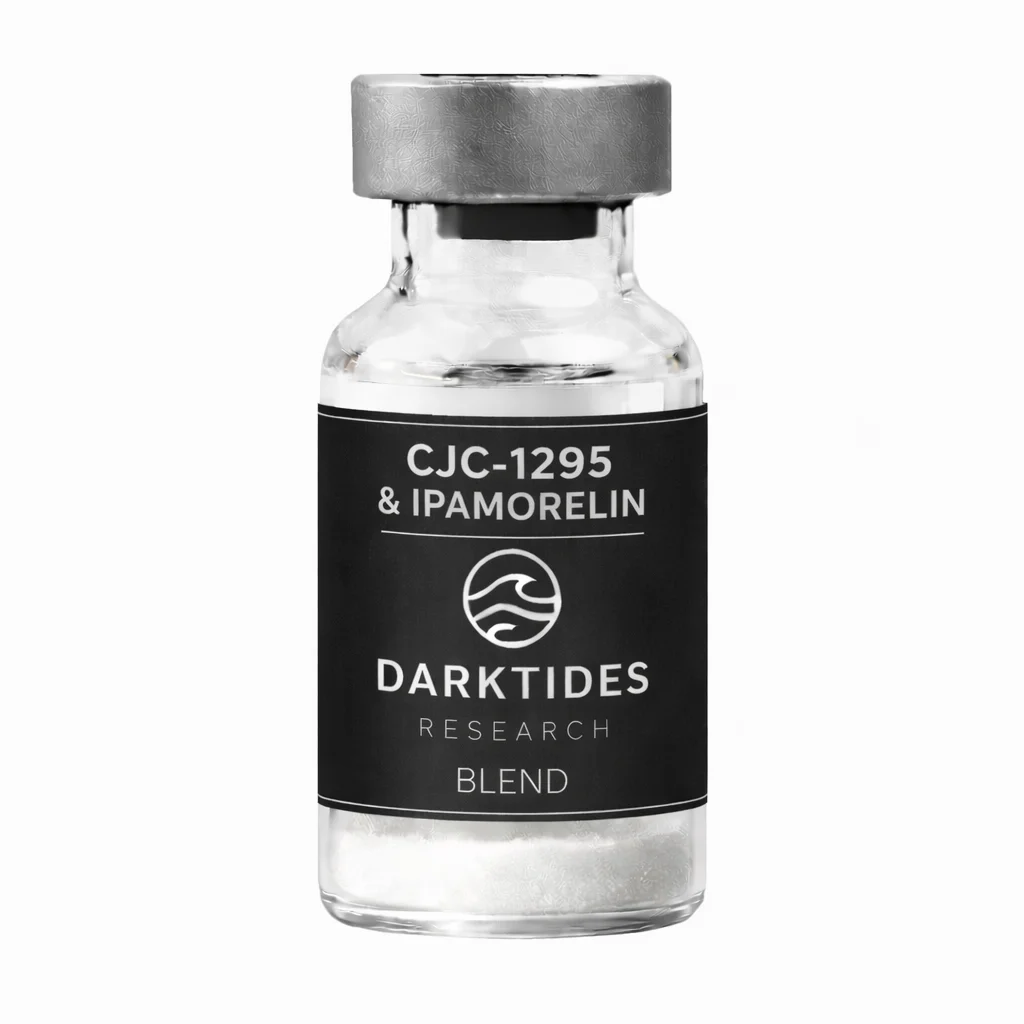
The CJC-1295 & Ipamorelin Blend is a research-grade synergistic peptide combination combining two complementary growth hormone secretagogues in a single lyophilized formulation. It is supplied as a sterile lyophilized powder in sealed vials. Each package contains ten vials, with each vial containing 5mg of CJC-1295 and 5mg of Ipamorelin (total 10mg). This product is manufactured exclusively for scientific investigation and in vitro laboratory experimentation.
Key Specifications at a Glance:
Quantity: 10 vials per pack
Composition: CJC-1295 (5mg), Ipamorelin (5mg)
Total per vial: 10mg
Form: Lyophilized (freeze-dried) powder
Purity: >99% verified by third-party testing
Research Focus: Growth hormone axis modulation, GHRH and GHSR pathways
Research Use Only: Not for human or animal consumption
Understanding the CJC-1295 & Ipamorelin Blend: The Research Context
The CJC-1295 & Ipamorelin Blend combines two distinct classes of growth hormone secretagogues that work through complementary mechanisms. This dual-pathway approach allows researchers to study the growth hormone axis from multiple angles simultaneously. CJC-1295 & Ipamorelin Blend
The Two Components of the Blend:
| Component | Quantity per Vial | Mechanism | Primary Research Interest |
|---|---|---|---|
| CJC-1295 | 5mg | GHRH receptor agonist (GHRHR) | Prolonged GHRH receptor activation |
| Ipamorelin | 5mg | GHSR agonist (ghrelin receptor) | Selective growth hormone release |
The Complementary Pathways:
Growth hormone secretion from the pituitary is regulated by two primary hypothalamic signals:
Growth Hormone-Releasing Hormone (GHRH): Stimulates growth hormone synthesis and release through GHRH receptors (GHRHR)
Ghrelin (via GHSR): Amplifies growth hormone release through growth hormone secretagogue receptors (GHSR)
CJC-1295 mimics GHRH, while Ipamorelin mimics ghrelin’s growth hormone-releasing effects without its other metabolic effects. By combining these two pathways, the blend allows researchers to study the integrated regulation of the growth hormone axis.
Third-Party Testing and Quality Assurance
Every batch of the CJC-1295 & Ipamorelin Blend undergoes rigorous independent analytical testing to verify identity, purity, and consistency. This third-party testing ensures that researchers receive a product that meets strict quality specifications before it is approved for release.
The testing process includes:
Identity verification through mass spectrometry for both peptides
Purity analysis using high-performance liquid chromatography (HPLC)
Batch-to-batch consistency checks
Residual solvent analysis to confirm complete lyophilization
With a verified purity exceeding 99%, this blend meets the high standards required for serious laboratory research applications. Each vial contains only the lyophilized research compound combination with no unnecessary additives, fillers, or excipients.
Component Profiles: The Two Peptides
CJC-1295 (5mg) — The GHRH Analog for Sustained GHRHR Activation
CJC-1295 is a synthetic analog of growth hormone-releasing hormone (GHRH), specifically a 30-amino acid peptide modified with a reactive lysine group for enhanced stability.
Key Research Interests:
GHRH receptor (GHRHR) activation and signaling
Growth hormone synthesis and secretion studies
Pituitary somatotroph function
Prolonged receptor activation kinetics
Structural Features of CJC-1295:
30-amino acid synthetic peptide
Modified with a reactive lysine group
Enhanced resistance to enzymatic degradation
Specifically targets GHRH receptors on pituitary somatotrophs
CJC-1295 functions by binding to and activating GHRH receptors, which are G-protein coupled receptors (GPCRs) on pituitary somatotroph cells. This activation stimulates both the synthesis and pulsatile release of growth hormone.
Ipamorelin (5mg) — The Selective GHSR Agonist
Ipamorelin is a synthetic pentapeptide and selective growth hormone secretagogue receptor (GHSR) agonist. It was developed as a third-generation growth hormone secretagogue with a distinct selectivity profile. CJC-1295 & Ipamorelin Blend
Key Research Interests:
GHSR (ghrelin receptor) activation and signaling
Growth hormone pulse amplitude modulation
Isolated GH axis activation (minimal off-target effects)
Structural Features of Ipamorelin:
Pentapeptide (5 amino acids)
Sequence: Aib-His-D-2-Nal-D-Phe-Lys-NH₂
Contains non-standard amino acids (Aib, D-2-Nal, D-Phe)
Enhanced enzymatic stability
Selective for GHSR with minimal effects on other pituitary hormones
Ipamorelin functions by binding to growth hormone secretagogue receptors (GHSR), also known as ghrelin receptors. Unlike earlier GHS compounds, Ipamorelin demonstrates high selectivity for growth hormone release with minimal effects on other pituitary hormones such as cortisol and prolactin. CJC-1295 & Ipamorelin Blend
The Synergy: Why Combine CJC-1295 and Ipamorelin?
Single-pathway growth hormone stimulation often produces limited responses due to the complex, redundant regulation of the growth hormone axis. The CJC-1295 & Ipamorelin Blend was designed to address both major regulatory pathways simultaneously.
The Dual-Pathway Principle:
| Pathway | Primary Peptide | Function |
|---|---|---|
| GHRH Pathway | CJC-1295 | Stimulates growth hormone synthesis and baseline pulsatile release |
| GHSR Pathway | Ipamorelin | Amplifies growth hormone pulse amplitude |
Why Dual-Pathway Research Matters:
GHRH receptor activation increases growth hormone synthesis and primes somatotrophs
GHSR activation amplifies the amplitude of growth hormone pulses
Combined activation may produce different signaling profiles than either pathway alone
Studying both pathways simultaneously provides a more complete picture of growth hormone axis regulation
Comparing Single vs. Combined Pathway Activation:
| Parameter | CJC-1295 Alone | Ipamorelin Alone | Blend (Both) |
|---|---|---|---|
| GH Synthesis | Increased | Minimal effect | Increased |
| GH Pulse Amplitude | Moderate | Moderate | Potentiated |
| Pulse Frequency | Maintained | Minimal effect | Maintained |
| Receptor Targets | GHRHR only | GHSR only | Both GHRHR + GHSR |
CJC-1295 vs. Modified GRF (1-29): Understanding the Difference
Researchers often encounter both CJC-1295 and Modified GRF (1-29) (sometimes called CJC-1295 no DAC). Understanding the distinction is important for experimental design.
| Feature | CJC-1295 (with DAC) | Modified GRF (1-29) (no DAC) |
|---|---|---|
| Structure | GHRH analog with reactive lysine | GHRH(1-29) analog |
| DAC (Drug Affinity Complex) | Yes (binds albumin for extended half-life) | No |
| Half-Life | Extended (days) | Short (minutes) |
| Primary Research Focus | Prolonged GHRH receptor activation | Pulsatile GHRH receptor activation |
The version included in this blend is the standard CJC-1295 formulation. Researchers should verify which analog is appropriate for their specific experimental design.
Chemical and Physical Properties
Molecular Characteristics of Each Component
| Component | Molecular Formula | Molecular Mass | Key Features |
|---|---|---|---|
| CJC-1295 | C₁₅₂H₂₅₂N₄₄O₄₂ | ~3367 g/mol | 30-amino acid GHRH analog |
| Ipamorelin | C₃₈H₄₉N₉O₅ | 711.85 g/mol | Pentapeptide with non-standard amino acids |
Physical Form and Storage
The product is supplied as a lyophilized (freeze-dried) powder within a sterile, sealed vial. The blend appears as a white to off-white homogeneous powder. CJC-1295 & Ipamorelin Blend
Recommended Storage Conditions:
Store lyophilized powder at -20°C (-4°F) or below for long-term preservation
Protect from light exposure
Keep desiccated to prevent moisture absorption
Allow vial to reach room temperature before opening to avoid condensation
Avoid repeated freeze-thaw cycles once reconstituted
Stability Considerations:
Both CJC-1295 and Ipamorelin are stable when stored properly in lyophilized form. The presence of D-amino acids in Ipamorelin enhances its resistance to enzymatic degradation. CJC-1295 & Ipamorelin Blend
Once reconstituted with an appropriate sterile solvent, the solution should be used promptly according to laboratory protocols.
Intended Use and Regulatory Status
Research Use Only
The CJC-1295 & Ipamorelin Blend is classified as a research chemical and is intended exclusively for laboratory and in vitro experimentation. This designation means the product is sold strictly for:
In vitro testing — experiments conducted in controlled laboratory environments
Cell culture studies — investigating pituitary somatotroph function
Receptor binding assays — studying GHRHR and GHSR interactions
Growth hormone axis research — investigating dual-pathway regulation
Analytical research — chemical analysis and characterization studies
Scientific investigation — basic research into peptide structure and function
Important Regulatory Notice
This product is not a drug, food, cosmetic, or medical device. Bodily introduction of any kind into humans or animals is strictly forbidden by law. The product should only be handled by licensed, qualified professionals working in appropriate laboratory facilities.
The supplier is a chemical supplier, not a compounding pharmacy or outsourcing facility under Sections 503A or 503B of the Federal Food, Drug, and Cosmetic Act. All product information provided is for educational purposes only and does not constitute medical advice or clinical recommendations. CJC-1295 & Ipamorelin Blend
Handling and Safety Guidelines
Professional Handling Required
The CJC-1295 & Ipamorelin Blend should only be handled by trained laboratory personnel wearing appropriate personal protective equipment (PPE), including:
Laboratory coat
Nitrile gloves
Safety goggles or face shield
Appropriate respiratory protection if aerosolization is possible
Reconstitution Protocol
For laboratory use, the lyophilized powder should be reconstituted with a sterile, compatible solvent. Standard practice includes:
Allow the sealed vial to reach room temperature — approximately 15-30 minutes
Clean the rubber stopper with an alcohol swab
Add the calculated volume of solvent to achieve desired concentration
Gently swirl or roll the vial between palms — do not shake vigorously to avoid foaming
Allow complete dissolution before use — this typically takes 5-10 minutes
Reconstitution Example for the Blend (5mg/5mg = 10mg total):
For researchers needing a 5mg/mL total concentration (2.5mg/mL each), add 2mL of sterile solvent. For a 10mg/mL total concentration (5mg/mL each), add 1mL of solvent. For a 2mg/mL total concentration (1mg/mL each), add 5mL of solvent. Always verify calculations based on specific experimental requirements. CJC-1295 & Ipamorelin Blend
Solvent Considerations:
Both peptides are water-soluble. Researchers should determine the appropriate solvent based on their specific experimental protocol. Common options include sterile water for injection, bacteriostatic water, or buffered solutions such as phosphate-buffered saline (PBS) at neutral pH.
Disposal Considerations
Dispose of the blend and any contaminated materials in accordance with federal, state, and local regulations for chemical waste disposal. Do not dispose of in regular trash or down drains unless permitted by local guidelines. CJC-1295 & Ipamorelin Blend
Research Applications
The CJC-1295 & Ipamorelin Blend is used in various laboratory research contexts, primarily focused on growth hormone axis regulation and pituitary cell biology. Typical applications include:
GHRHR and GHSR Dual-Pathway Studies:
The primary research interest in this blend revolves around the simultaneous activation of both major growth hormone regulatory pathways. Researchers use the blend to study:
GHRHR and GHSR signaling interactions
Synergistic effects on growth hormone secretion
Receptor crosstalk and signal integration
Comparative signaling profiles of single vs. dual pathway activation
Pituitary Cell Culture Studies:
Researchers use the blend in controlled pituitary cell culture systems to investigate:
Somatotroph function and responsiveness
Growth hormone synthesis and secretion dynamics
Pituitary cell signaling pathways
Receptor regulation and desensitization
Growth Hormone Pulse Dynamics Research:
The complementary mechanisms of CJC-1295 (increasing baseline secretion) and Ipamorelin (amplifying pulse amplitude) allow researchers to study:
Growth hormone pulse generation mechanisms
Factors affecting pulse amplitude and frequency
Hypothalamic-pituitary integration
Feedback regulation of the growth hormone axis
GPCR Signaling Research:
Both CJC-1295 (via GHRHR) and Ipamorelin (via GHSR) activate distinct GPCRs. The blend serves as a research tool for:
Comparing Gs (GHRHR) and Gq (GHSR) signaling pathways
Studying receptor cross-talk in the same cell type
GPCR signaling integration and convergence
Downstream effector activation (cAMP, IP3, calcium)
In Vitro Efficacy Studies:
Researchers use the blend to study:
Concentration-response relationships for growth hormone release
Time-course of receptor activation and signaling
Synergistic effects of dual-pathway activation
Receptor selectivity and specificity
Comparative Mechanism Research:
The blend allows investigators to compare:
Effects of GHRHR activation vs. GHSR activation
Single-pathway vs. dual-pathway signaling outcomes
Different growth hormone secretagogue classes
Researchers should design their experimental protocols based on peer-reviewed literature and established laboratory practices specific to growth hormone secretagogues. CJC-1295 & Ipamorelin Blend
What Makes This Product Different
Pre-Formulated Dual-Pathway Blend
Unlike individual research peptides that require separate handling, reconstitution, and combination, this blend combines two complementary growth hormone secretagogues into a single vial at an optimal 1:1 ratio. This structured approach supports consistency, efficiency, and reproducibility in research settings.
Complementary Mechanisms
The blend combines a GHRH analog (CJC-1295) with a GHSR agonist (Ipamorelin), targeting both major pathways that regulate growth hormone secretion. This dual-pathway approach allows researchers to study the integrated regulation of the growth hormone axis.
Synergistic Research Potential
The combination of CJC-1295 and Ipamorelin allows researchers to study potential synergistic effects that cannot be observed with either peptide alone. The blend addresses both growth hormone synthesis (via GHRHR) and pulse amplitude modulation (via GHSR).
Optimal 1:1 Ratio
The 5mg/5mg (1:1) ratio reflects the different effective concentration ranges of each peptide, providing researchers with a balanced formulation for dual-pathway studies. CJC-1295 & Ipamorelin Blend
Rigorous Quality Control
Unlike research chemicals sold without verification, this blend comes with documented third-party testing for every batch. This commitment to quality assurance gives researchers confidence in the consistency and reliability of their experimental results.
Complete Documentation
Each product listing includes full chemical specifications and component quantities. This transparency allows researchers to verify the exact formulation they are working with.
Appropriate Packaging for Research Use
The sterile, sealed vial packaging protects the lyophilized powder from environmental contaminants. The 5mg/5mg blend provides researchers with a standardized formulation for reproducible experimentation. CJC-1295 & Ipamorelin Blend
Batch Traceability
Each package of the blend includes batch identification numbers that allow researchers to trace their material back to original manufacturing and testing records. This traceability is essential for reproducible research and quality documentation.
Frequently Asked Questions for Researchers
What is the purity level of the blend?
Each batch is tested to verify purity exceeding 99% for both components. Individual certificates of analysis are available upon request.
How should the lyophilized powder be stored?
Store at -20°C or below, protected from light and moisture. Avoid repeated freeze-thaw cycles once reconstituted.
What solvent should be used for reconstitution?
Both peptides are water-soluble. Researchers should determine the appropriate solvent based on their specific experimental protocol. Common options include sterile water for injection, bacteriostatic water, or buffered solutions such as PBS at neutral pH.
Is this product sterile?
The lyophilized powder is manufactured under aseptic conditions, but researchers should follow standard laboratory practices for handling research chemicals. For cell culture applications, additional filtration using a 0.22-micron filter may be appropriate.
What is the ratio of CJC-1295 to Ipamorelin in this blend?
The blend contains a 1:1 ratio — 5mg of CJC-1295 and 5mg of Ipamorelin per vial (total 10mg).
How does this blend differ from using the peptides separately?
The pre-formulated blend ensures consistent 1:1 ratios across experiments and simplifies handling. For research requiring independent dose variation, separate vials may be preferred.
What is the difference between CJC-1295 and Modified GRF (1-29)?
CJC-1295 includes a Drug Affinity Complex (DAC) that binds to albumin, extending its half-life. Modified GRF (1-29) lacks this modification and has a shorter half-life. The version in this blend is CJC-1295 with DAC.
Why combine CJC-1295 and Ipamorelin?
They target complementary pathways: CJC-1295 activates GHRH receptors (increasing GH synthesis and baseline pulsatile release), while Ipamorelin activates GHSR (amplifying GH pulse amplitude). Combined activation may produce different signaling profiles than either pathway alone.
Can this blend be used in combination with other research reagents?
Researchers should determine compatibility based on their specific experimental design. Standard laboratory practice includes testing interactions in control experiments before full-scale implementation.
Final Notes for Laboratory Researchers
The CJC-1295 & Ipamorelin Blend represents a high-purity research tool for qualified professionals conducting legitimate scientific investigations into growth hormone axis regulation, GHRHR and GHSR signaling, pituitary somatotroph function, and related endocrinological fields. With documented third-party testing, complete chemical specifications, and appropriate packaging for laboratory use, this product meets the standards expected by serious researchers.
The pre-formulated 1:1 blend offers researchers the ability to study dual-pathway growth hormone regulation simultaneously, including GHRH receptor activation (CJC-1295) and GHSR activation (Ipamorelin), providing a more complete picture of growth hormone axis regulation than either pathway alone.
For research use only. Not for human or animal consumption. Handle only in appropriate laboratory facilities with proper safety equipment and training.


Reviews
There are no reviews yet.