MOTS-C 10mg for Sale
$79.97
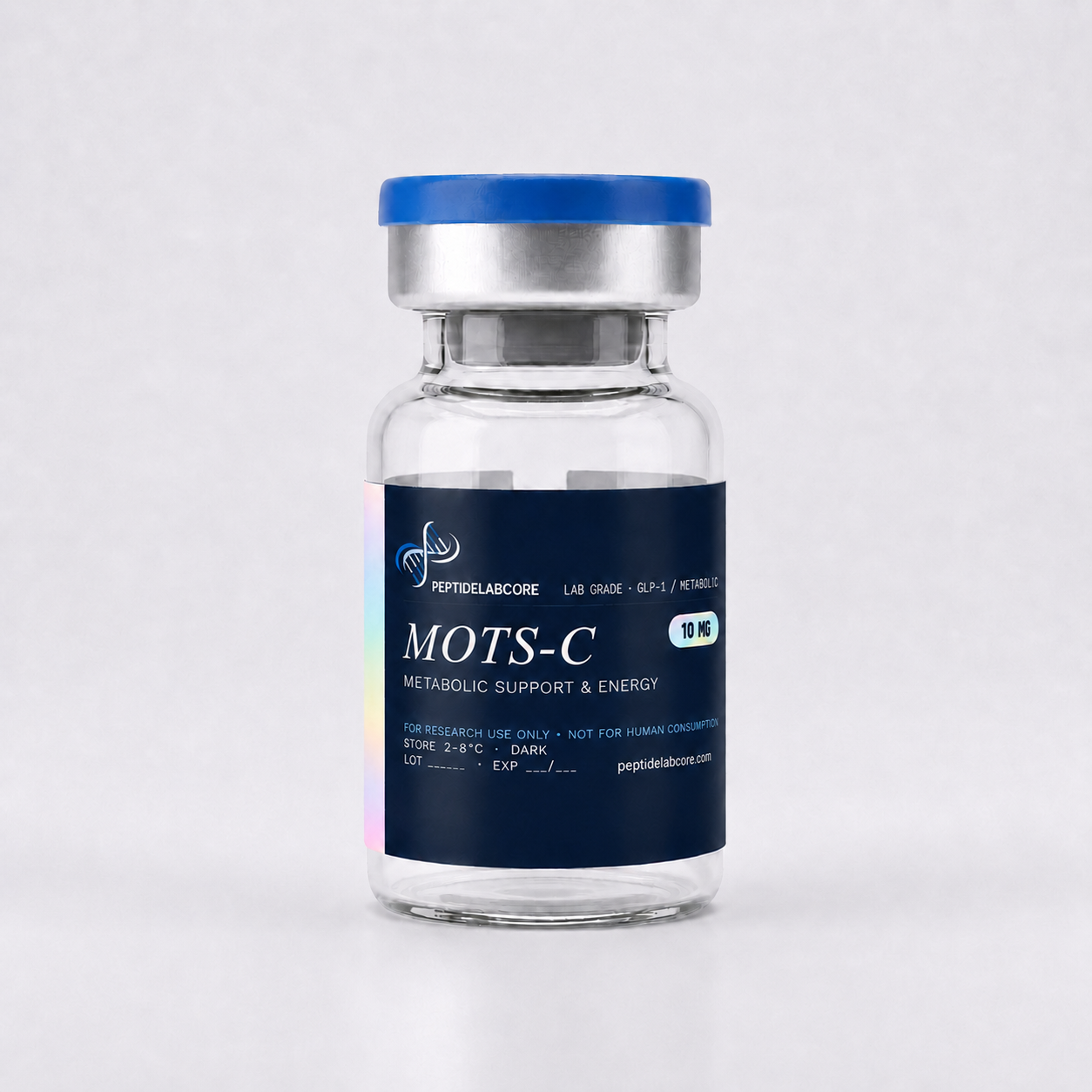
MOTS-C 10MG (10mg x 10) is a high-purity mitochondrial-derived research peptide supplied as a lyophilized powder in sterile vials. Each batch undergoes independent third-party testing to verify identity and purity (≥98%). With a molecular mass of 2174.6 and CAS number 1627580-64-6, this research chemical is intended exclusively for laboratory and in vitro experimentation. For research use only — not for human consumption
MOTS-C 10MG Research Peptide — Mitochondrial-Derived Peptide for Metabolic Research
Product Overview
MOTS-C (Mitochondrial Open Reading Frame of the 12S rRNA-c) is a research-grade mitochondrial-derived peptide (MDP) encoded within the mitochondrial genome. It is supplied as a sterile lyophilized powder in sealed vials. Each package contains ten vials, with each vial holding 10mg of the research compound. This product is manufactured exclusively for scientific investigation and in vitro laboratory experimentation.
Key Specifications at a Glance:
Quantity: 10mg per vial, 10 vials per pack
Form: Lyophilized (freeze-dried) powder
Purity: ≥98% verified by third-party testing
Molecular Formula: C₁₀₁H₁₅₂N₂₈O₂₂S₂
Molecular Mass: 2174.6
CAS Number: 1627580-64-6
Sequence: MRWQEMGYIFYPRKLR (H-Met-Arg-Trp-Gln-Glu-Met-Gly-Tyr-Ile-Phe-Tyr-Pro-Arg-Lys-Leu-Arg-OH)
Research Use Only: Not for human or animal consumption
Understanding MOTS-C: The Research Context
MOTS-C is a synthetic research peptide that corresponds to a naturally occurring mitochondrial-derived peptide encoded within the mitochondrial genome. Unlike most peptides that are encoded by nuclear DNA, MOTS-C is one of a growing class of peptides encoded by short open reading frames (sORFs) within mitochondrial DNA (mtDNA). MOTS-C 10mg
Key Research Interests:
AMPK pathway activation and metabolic regulation
Glucose metabolism and insulin sensitivity
Anti-aging and mitochondrial function
Osteogenic differentiation and bone metabolism
Antiviral and immune regulation
In vitro cell culture investigations
Researchers utilize MOTS-C in controlled laboratory settings to study the emerging field of mitochondrial-derived peptides and their roles in cellular metabolism. The peptide is of particular interest to investigators focused on metabolic disorders, mitochondrial dysfunction, aging biology, and the fundamental mechanisms of intercellular signaling. MOTS-C 10mg
The Significance of Mitochondrial-Derived Peptides:
Mitochondria are organelles traditionally known for energy production, but research has revealed that they also produce signaling molecules, including a family of peptides encoded within mitochondrial DNA. MOTS-C is a 16-amino acid peptide that has been the subject of research into its potential roles in :
Metabolic regulation through AMPK activation
Anti-aging and cell protection mechanisms
Antiviral and immune modulation
Systemic metabolic homeostasis
The MOTS-C Amino Acid Sequence
MOTS-C is a 16-amino acid peptide with the following sequence :
Full Sequence: H-Met-Arg-Trp-Gln-Glu-Met-Gly-Tyr-Ile-Phe-Tyr-Pro-Arg-Lys-Leu-Arg-OH
Abbreviated Sequence: MRWQEMGYIFYPRKLR
Key Sequence Features:
Contains multiple aromatic amino acids (tryptophan, tyrosine, phenylalanine)
Includes positively charged residues (arginine, lysine)
Contains two methionine residues
Length of 16 amino acids
Molecular weight: 2174.6
The presence of multiple aromatic and positively charged residues contributes to the peptide’s structural properties and potential interaction with cellular targets.
MOTS-C 10MG vs. 5MG vs. 20MG vs. 40MG: Choosing the Right Quantity
Researchers often ask which quantity best suits their laboratory protocols. MOTS-C is available in multiple vial sizes to accommodate different research scales:
| Feature | MOTS-C 5MG | MOTS-C 10MG | MOTS-C 20MG | MOTS-C 40MG |
|---|---|---|---|---|
| Quantity per vial | 5mg | 10mg | 20mg | 40mg |
| Vials per pack | 10 | 10 | 10 | 10 |
| Total quantity | 50mg | 100mg | 200mg | 400mg |
| Best for | Pilot studies, small-scale screening | Moderate studies, standard assays | Large-scale experiments | High-throughput research |
Choosing the Right Vial Size:
MOTS-C 5MG — Ideal for preliminary pilot studies, initial dose-finding experiments, and research requiring precise handling of smaller quantities
MOTS-C 10MG — Suitable for moderate-scale studies, standard cell culture experiments, and protocols requiring more material per vial
MOTS-C 20MG & 40MG — Best for large-scale experiments, extended time-course studies, high-throughput screening, and maximum cost efficiency
All sizes share identical chemical properties, purity standards (≥98%), and quality assurance protocols. The choice depends on the specific requirements of your research design and the scale of your experiments.
Third-Party Testing and Quality Assurance
Every batch of MOTS-C undergoes rigorous independent analytical testing to verify identity, purity, and consistency. This third-party testing ensures that researchers receive a product that meets strict quality specifications before it is approved for release . MOTS-C 10mg
The testing process includes:
Identity verification through mass spectrometry (ESI-MS)
Purity analysis using high-performance liquid chromatography (HPLC) — ≥98% purity
Acetate content analysis (≤12.0%)
Peptide content analysis (≥80.0%)
Water content analysis (≤10.0% via Karl Fischer)
Mass balance verification (95.0% ~ 105.0%)
With verified purity of 98% or higher, MOTS-C meets the high standards required for serious laboratory research applications. Each vial contains only the lyophilized research compound with no unnecessary additives, fillers, or excipients. MOTS-C 10mg
Biological Activity and Mechanism of Action
MOTS-C is known to exert its biological effects primarily through activation of the AMPK (AMP-activated protein kinase) pathway and modulation of the folate cycle . MOTS-C 10mg
Key Biological Activities Reported in Research Literature:
| Research Area | Observed Effects | Concentration/Dose |
|---|---|---|
| Metabolic Regulation | Increases glucose clearance, activates AMPK, increases GLUT4 expression | 0.5 mg/kg/day |
| Anti-Obesity | Prevents high-fat diet-induced obesity and insulin resistance | 5 mg/kg |
| Osteogenic Differentiation | Increases osteogenic differentiation and calcified nodule formation | 1 μM |
| Cardiovascular | Reduces AT1 and ETB receptor levels, attenuates aortic calcification | 5 mg/kg |
AMPK Activation Pathway:
MOTS-C induces the accumulation of the endogenous AMP analog AICAR (5-aminoimidazole-4-carboxamide ribonucleotide), increases activation of AMPK, and promotes expression of its downstream target GLUT4. This mechanism is central to its effects on glucose uptake and insulin sensitivity, as well as its ability to counteract diet-induced obesity. MOTS-C 10mg
Anti-Aging and Cell Protection:
MOTS-C is associated with life extension by improving mitochondrial function, activating antioxidant pathways, and delaying cellular aging phenotypes. Studies have shown that it can reduce oxidative stress damage, maintain mitochondrial homeostasis, and thus protect cell function .
Chemical and Physical Properties
Molecular Characteristics
Detailed Molecular Information:
Molecular Formula: C₁₀₁H₁₅₂N₂₈O₂₂S₂
Molecular Mass: 2174.6 daltons
CAS Number: 1627580-64-6
Sequence: MRWQEMGYIFYPRKLR
Number of Amino Acids: 16
Appearance: White to off-white lyophilized powder
Density: 1.44±0.1 g/cm³ (Predicted)
Structural Features:
Linear peptide (non-cyclic)
Contains two methionine residues (susceptible to oxidation)
Multiple aromatic residues (Trp, Tyr, Phe)
Positively charged residues at positions 2, 13, 14, and 16
Physical Form and Storage
The product is supplied as a lyophilized (freeze-dried) powder within a sterile, sealed vial. Lyophilization preserves the chemical integrity of the peptide by removing water content while maintaining the compound’s structure. MOTS-C 10mg
Recommended Storage Conditions:
Store lyophilized powder at -20°C (-4°F) or below for long-term preservation (stable for up to 3 years)
For extended storage, -80°C is recommended for stock solutions
Protect from light exposure
Keep desiccated to prevent moisture absorption
Allow vial to reach room temperature before opening to avoid condensation
Avoid repeated freeze-thaw cycles once reconstituted
Shelf life: 24 months when stored under recommended conditions
Stability Considerations:
MOTS-C contains methionine residues, which can be susceptible to oxidation. For this reason, minimizing air exposure and avoiding repeated opening of stock vials is particularly important. Once reconstituted, solutions should be stored in separate aliquots to prevent repeated freeze-thaw cycles .
Solubility Information:
DMSO: ≥1 mg/mL
For aqueous applications, test solubility in your specific buffer system
To increase solubility, heat the tube to 37°C and then oscillate in an ultrasonic bath
Intended Use and Regulatory Status
Research Use Only
MOTS-C is classified as a research chemical and is intended exclusively for laboratory and in vitro experimentation. This designation means the product is sold strictly for:
In vitro testing — experiments conducted in controlled laboratory environments
Cell culture studies — investigating AMPK pathway activation and metabolic signaling
Metabolic research — studying glucose metabolism, insulin sensitivity, and energy homeostasis
Aging research — investigating mitochondrial function and cellular senescence
Osteogenic research — studying bone formation and differentiation pathways
Antiviral research — exploring mitochondrial biogenesis and immune modulation
Analytical research — chemical analysis and characterization studies
Scientific investigation — basic research into mitochondrial-derived peptides
Important Regulatory Notice
This product is not a drug, food, cosmetic, or medical device. Bodily introduction of any kind into humans or animals is strictly forbidden by law. The product should only be handled by licensed, qualified professionals working in appropriate laboratory facilities.
Products are for research use only. Not for human use. Suppliers do not sell to patients or individuals. MOTS-C 10mg
The supplier is a chemical supplier, not a compounding pharmacy or outsourcing facility under Sections 503A or 503B of the Federal Food, Drug, and Cosmetic Act. All product information provided is for educational and research purposes only and does not constitute medical advice or clinical recommendations. MOTS-C 10mg
Handling and Safety Guidelines
Professional Handling Required
MOTS-C should only be handled by trained laboratory personnel wearing appropriate personal protective equipment (PPE), including:
Laboratory coat
Nitrile gloves
Safety goggles or face shield
Appropriate respiratory protection if aerosolization is possible
Reconstitution Protocol
For laboratory use, the lyophilized powder should be reconstituted with a sterile, compatible solvent. Standard practice includes :
Allow the sealed vial to reach room temperature — approximately 15-30 minutes
Clean the rubber stopper with an alcohol swab
Add the calculated volume of solvent to achieve desired concentration
Gently swirl or roll the vial between palms — do not shake vigorously to avoid foaming
Allow complete dissolution before use — this typically takes 2-5 minutes
For increased solubility, heat the tube to 37°C and then oscillate in an ultrasonic bath
Reconstitution Example for MOTS-C 10MG:
For researchers needing a 10mg/mL working solution, add 1mL of sterile solvent to the 10mg vial. For a 5mg/mL solution, add 2mL of solvent. For a 2mg/mL solution, add 5mL of solvent. Always verify calculations before proceeding with experiments. MOTS-C 10mg
Solvent Considerations:
DMSO: Soluble at ≥1 mg/mL for stock solutions
Aqueous solutions: Test solubility in your specific buffer system
General tips: Prepare stock solutions in separate aliquots to avoid product failure caused by repeated freezing and thawing
Stock Solution Storage:
Once prepared, store stock solutions in separate aliquots to avoid repeated freezing and thawing. When stored at -80°C, use within 6 months; when stored at -20°C, use within 1 month .
Disposal Considerations
Dispose of MOTS-C and any contaminated materials in accordance with federal, state, and local regulations for chemical waste disposal. Do not dispose of in regular trash or down drains unless permitted by local guidelines.
Research Applications
MOTS-C is used in various laboratory research contexts, primarily focused on metabolic regulation, AMPK signaling, and aging biology. Typical applications include :
AMPK Pathway and Metabolic Research:
The primary research interest in MOTS-C revolves around its activation of the AMPK pathway. Researchers use MOTS-C to study:
AMPK activation mechanisms and downstream signaling
Glucose uptake and insulin sensitivity in cell culture models
Glycolysis regulation and metabolic flux
Prevention of high-fat diet-induced metabolic changes
GLUT4 expression and translocation
Anti-Obesity and Metabolic Disorder Research:
MOTS-C has been shown to counteract diet-induced obesity and insulin resistance by activating AMPK. Research applications include:
Adipose tissue metabolism studies
Fatty acid oxidation regulation
Insulin resistance models
Metabolic syndrome investigations
Aging and Mitochondrial Research:
MOTS-C is associated with improved mitochondrial function and anti-aging effects. Research applications include:
Mitochondrial homeostasis studies
Cellular senescence markers
Oxidative stress reduction mechanisms
Longevity pathway investigations
Age-related metabolic changes
Antiviral and Immune Regulation Research:
Recent studies indicate that MOTS-C inhibits viral replication and improves liver function in chronic hepatitis B (HBV) infection by promoting mitochondrial biogenesis and activating antiviral signaling pathways. Research applications include:
Viral replication studies
Mitochondrial biogenesis investigations
Antiviral signaling pathway research
Cell Culture Investigations:
Researchers use MOTS-C in controlled cell culture systems to study:
AMPK activation and downstream gene expression
Glucose metabolism in various cell lines
Cellular responses to mitochondrial peptide signaling
Gene expression changes following peptide treatment
In Vivo Research Models:
Preclinical research has utilized MOTS-C in animal models with observations including:
Improved glucose clearance at 0.5 mg/kg/day
Prevention of high-fat diet-induced obesity at 5 mg/kg
Increased AMPK activation in skeletal muscle
Reduced AT1 and ETB receptor levels in cardiovascular models
Researchers should design their experimental protocols based on peer-reviewed literature and established laboratory practices specific to mitochondrial-derived peptides.
What Makes This Product Different
Mitochondrial Genome Origin
Unlike the vast majority of research peptides that are encoded by nuclear DNA, MOTS-C is encoded within the mitochondrial genome. This unique origin makes MOTS-C a valuable research tool for investigators studying mitochondrial biology and the emerging field of mitochondrial-derived signaling molecules .
AMPK Pathway Activation
MOTS-C is a well-characterized activator of the AMPK pathway, a central regulator of cellular energy homeostasis. This specific mechanism of action distinguishes MOTS-C from peptides that target other signaling pathways. It induces the accumulation of the endogenous AMP analog AICAR, leading to sustained AMPK activation .
Broad Research Applications
MOTS-C has been validated across multiple research domains, including:
Metabolic research (glucose homeostasis, insulin sensitivity, anti-obesity)
Aging research (mitochondrial function, cellular senescence)
Antiviral research (HBV, mitochondrial biogenesis)
Cardiovascular research (vascular calcification models)
Optimal 10MG Research Quantity
The 10mg vial size is ideal for:
Moderate-scale studies requiring consistent batch material
Standard cell culture experiments and receptor binding assays
Multiple experiments without vial-to-vial variation
Cost-effective quantity for established research protocols
Available in Multiple Vial Sizes for Research Scalability
MOTS-C is available in multiple vial sizes—5mg, 10mg, 20mg, and 40mg—allowing researchers to scale their experiments efficiently. The 10mg size offers a balanced quantity for most standard research application. MOTS-C 10mg
Rigorous Quality Control
Unlike research chemicals sold without verification, MOTS-C comes with documented third-party testing for every batch. This commitment to quality assurance gives researchers confidence in the consistency and reliability of their experimental results. Testing includes HPLC purity analysis, mass spectrometry identity confirmation, acetate content analysis, and water content verification .
Complete Documentation
Each product listing includes full chemical specifications, including molecular formula, molecular mass, CAS number, and amino acid sequence. Batch-specific certificates of analysis are available upon request.
Appropriate Packaging for Research Use
The sterile, sealed vial packaging protects the lyophilized powder from environmental contaminants. The 10mg concentration is optimized for laboratory research applications requiring moderate quantities. MOTS-C 10mg
Batch Traceability
Each package of MOTS-C includes batch identification numbers that allow researchers to trace their material back to original manufacturing and testing records. This traceability is essential for reproducible research and quality documentation.
Frequently Asked Questions for Researchers
What is the purity level of MOTS-C?
Each batch is tested to verify purity of ≥98% via HPLC. Individual certificates of analysis are available upon request. MOTS-C 10mg
What are the available sizes for MOTS-C?
MOTS-C is available in multiple vial sizes: 5mg, 10mg, 20mg, and 40mg per vial. The 10mg size comes in packages of 10 vials (100mg total) .
What is the molecular weight of MOTS-C?
The molecular weight of MOTS-C is 2174.6 .
What is the CAS number for MOTS-C?
The CAS number is 1627580-64-6 .
What is the amino acid sequence of MOTS-C?
The sequence is MRWQEMGYIFYPRKLR (H-Met-Arg-Trp-Gln-Glu-Met-Gly-Tyr-Ile-Phe-Tyr-Pro-Arg-Lys-Leu-Arg-OH) .
How should the lyophilized powder be stored?
Store at -20°C or below, protected from light and moisture. Due to the presence of methionine residues, minimizing air exposure is particularly important. The powder has a shelf life of 24 months when stored properly .
What solvent should be used for reconstitution?
MOTS-C is soluble in DMSO at ≥1 mg/mL for stock solutions. For aqueous applications, test solubility in your specific buffer system. Researchers should determine the appropriate solvent based on their specific experimental protocol. MOTS-C 10mg
How should stock solutions be stored?
Once prepared, store stock solutions in separate aliquots to avoid repeated freeze-thaw cycles. When stored at -80°C, use within 6 months; when stored at -20°C, use within 1 month .
Is this product sterile?
The lyophilized powder is manufactured under aseptic conditions, but researchers should follow standard laboratory practices for handling research chemicals. For cell culture applications, additional filtration using a 0.22-micron filter may be appropriate.
What is the mechanism of action of MOTS-C?
MOTS-C activates the AMPK pathway by inducing accumulation of the endogenous AMP analog AICAR, leading to increased glucose uptake, improved insulin sensitivity, and prevention of diet-induced obesity. MOTS-C 10mg
What research applications is MOTS-C used for?
MOTS-C is studied in metabolic research (obesity, diabetes, insulin resistance), aging research (mitochondrial function, cellular senescence), antiviral research (HBV, mitochondrial biogenesis), and AMPK signaling pathway investigations in laboratory cell culture and research models .
Can MOTS-C be used in combination with other research peptides?
Researchers should determine compatibility based on their specific experimental design. Standard laboratory practice includes testing interactions in control experiments before full-scale implementation. MOTS-C 10mg
Final Notes for Laboratory Researchers
MOTS-C 10MG represents a high-purity research tool for qualified professionals conducting legitimate scientific investigations into mitochondrial-derived peptides, AMPK signaling, metabolic regulation, aging biology, and related fields. With documented third-party testing, complete chemical specifications, and appropriate packaging for laboratory use, this product meets the standards expected by serious researchers. MOTS-C 10mg
The 10MG vial size is specifically optimized for moderate-scale research applications requiring consistent batch material for standard cell culture studies, metabolic assays, and AMPK pathway investigations. As a peptide encoded by mitochondrial DNA with well-characterized AMPK-activating properties, MOTS-C offers unique research opportunities in the growing fields of mitochondrial signaling, metabolic regulation, and aging biology. MOTS-C 10mg
For research use only. Not for human or animal consumption. Handle only in appropriate laboratory facilities with proper safety equipment and training. MOTS-C 10mg
Related products